In order to make it easier for customers to integrate the card reader into their own devices, we have made the core function of the card reader into a stamp hole encapsulated module, which is only 16mm╳30mm in size, and is available in two different models: external antenna and on-board antenna.
Users as long as in their own circuit board mounted reader module, can easily have a long-distance range to read active electronic tags, not only can read the label ID, but also know the distance of the label, and quickly realize a variety of applications based on the label positioning technology program.
A number of readers work together, you can determine the effective range of the specific location of the electronic tags, to achieve real-time monitoring of the location of personnel, goods, to facilitate the tracking and finding of personnel, goods. Tag positioning is widely used in intelligent warehouse management, logistics tracking, indoor navigation, personnel management and many other applications.
The card reader module integrates a receiving antenna module, a low-noise amplifier module, a power supply module, and an external TTL level asynchronous serial communication interface, with a reading distance of up to 100 meters.
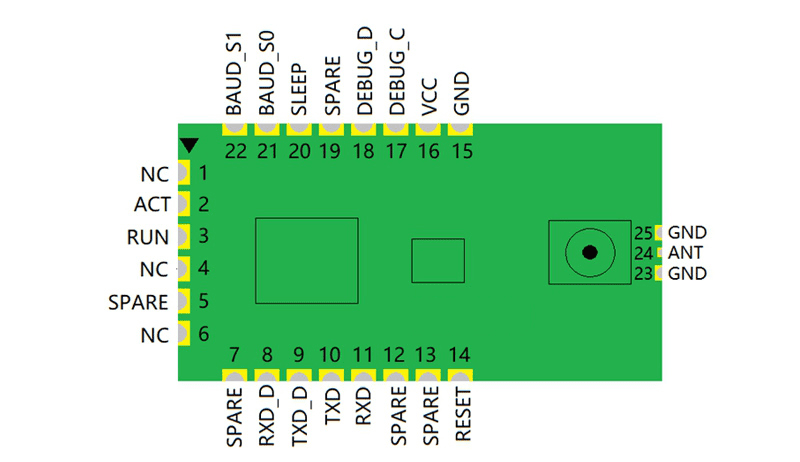
Output, receiving a tag signal sends out a 50ms positive pulse (VLmax:0.4V, VHmin:2.4V)
3
RUN
running indication
output, the module sends out a 50ms positive pulse per second (VLmax:0.4V, VHmin:2.4V)
4
NC
unoccupied
Suggested Suspension
5
SPARE
reserve
Suggested Suspension
6
NC
unoccupied
Suggested Suspension
7
SPARE
reserve
Suggested Suspension
8
RXD_D
Debugging serial port (receive)
Input (VLmax:0.6V, VHmin:2.1V)
9
TXD_D
Debugging serial port (send)
Output (VLmax:0.4V, VHmin:2.4V)
10
TXD
Communication serial port (transmit)
Output (VLmax:0.4V, VHmin:2.4V)
11
RXD
Communication serial port (receive)
Input (VLmax:0.6V, VHmin:2.1V)
12
SPARE
reserve
Suggested Suspension
13
SPARE
reserve
Suggested Suspension
14
RESET
Module reset
Pull down the pin for more than 100ms to reset the module. (VLmax:0.6V, VHmin:2.1V)
15
GND
Power (Ground)
16
VCC
Voltage (positive)
Module power supply, 3.3V recommended (2.0V~3.6V)
17
DEBUG_C
Debugging (clock)
For updating module firmware
18
DEBUG_D
Commissioning (data)
For updating module firmware
19
SPARE
reserve
Suggested Suspension
20
SLEEP
sleep control
Input (VLmax:0.6V, VHmin:2.1V), low level to sleep state (current less than 10uA)
21
BAUD_S0
Serial port baud rate setting bit 0
Setting the baud rate of the main serial port
22
BAUD_S1
Serial baud rate setting 1 bit
23
GND
antennae
Direct connection to signal ground possible (M01 module only)
24
ANT
connection with high-ranking officials
Instead of using the IPX antenna holder on the module, the external antenna is connected directly through the circuit board.
25
GND
antennae
Directly connectable to signal ground
Related drawings
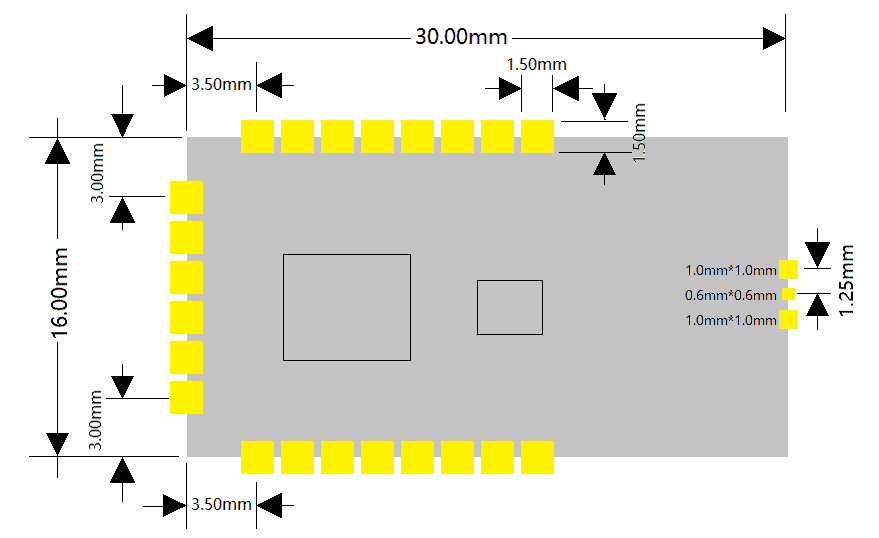
Package Size
When designing the backplane package, you only need to place a 1.5mm*1.5mm square pad at the corresponding position of the stamp hole pin, a 1.0mm*1.0mm pad at the corresponding position of the antenna ground, and a -0.6mm*0.6mm pad at the corresponding position of the antenna.
If the on-board antenna on the module is used, or if the IPX antenna holder on the module is used, the pads corresponding to the antenna can be designed without.
As shown in the figure below:
On-Board PCB Antenna Placement Instructions
Option 1 (recommended):
Place the module along the edge of the PCB with the on-board antenna outside the board frame.
Program 2:
Place the module PCB edge to edge, with the on-board antenna placed along the edge of the board and hollowed out underneath.
Program 3:
Place the module PCB edge to edge and the on-board antenna along the edge of the board without copper cladding.
IO Pin Alignment Recommendations
For some applications with high power consumption and EMI characteristics, it is recommended to connect 10~100 ohm resistors in series on the I/O lines. This will suppress overshoot and smooth out the signal when the power is switched on and off. Series resistors also provide some protection against electrostatic discharge (ESD).
Antenna recommendations from the circuit board
Instead of using the on-board PCB antenna and leading the antenna from the IPX antenna holder on the module, the antenna is led directly from the antenna pin of the module via the baseboard. When designing the antenna alignment on the baseboard, it is necessary to ensure that the ANT antenna has a line impedance of 50 ohms to achieve the best antenna signal transmission effect.













 English
  简体中文
简体中文