







In fresh delivery and cold-chain transfer, once cabin temperature or humidity drifts off range, spoilage and compliance risk rise fast. Hand logs or single-point recorders rarely cover continuous in-transit sensing plus vehicle/slot linkage. West Electronics uses the active temp/humidity tag WE-T96 as the vehicle-side sensing end: the tag has built-in sensors, reports temp/humidity and battery-related fields on a fixed wireless cycle, and a companion reader aggregates data for the user platform or local system. This page is a desensitized scenario; numbers come only from the live product page and the public manual.Related products list only WE-T96, with no customer names or pricing.
Customer pain points
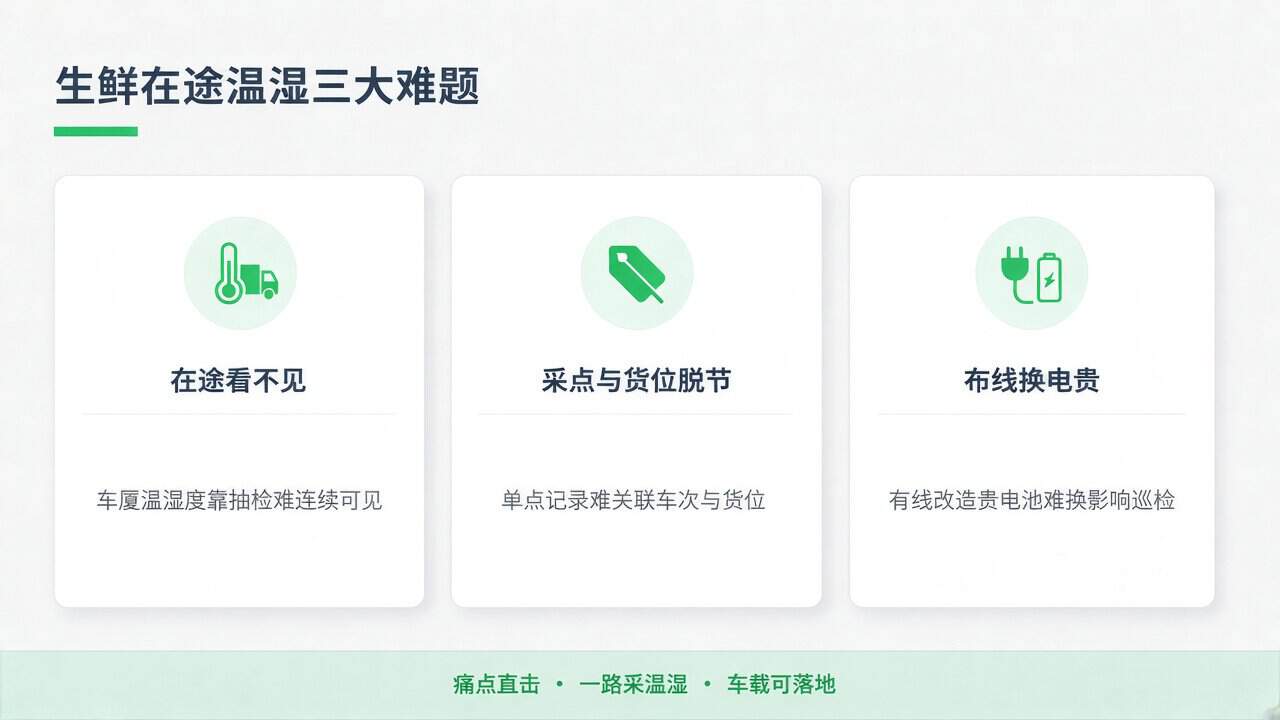
- In-transit temp/humidity not visible: After a fresh-goods truck leaves the depot, drivers and dispatchers rarely see live cabin temp/humidity; issues often show up only at unload.
- Sensing points disconnected from slots: With only a master meter and no tag that moves with the crate or slot, which truck or zone overheated stays unclear.
- Wiring and battery-swap cost: Hardwired vehicle power retrofits cost more and probe wiring is hard; you need a low-power, replaceable-battery wireless tag with enough protection.
- Also need find-goods: Some fresh warehouse/delivery ops also want temp/humidity plus fast find-goods—the same active-tag family can extend to location/find (this page focuses on temp/humidity; find-goods is a side note).
Solution architecture
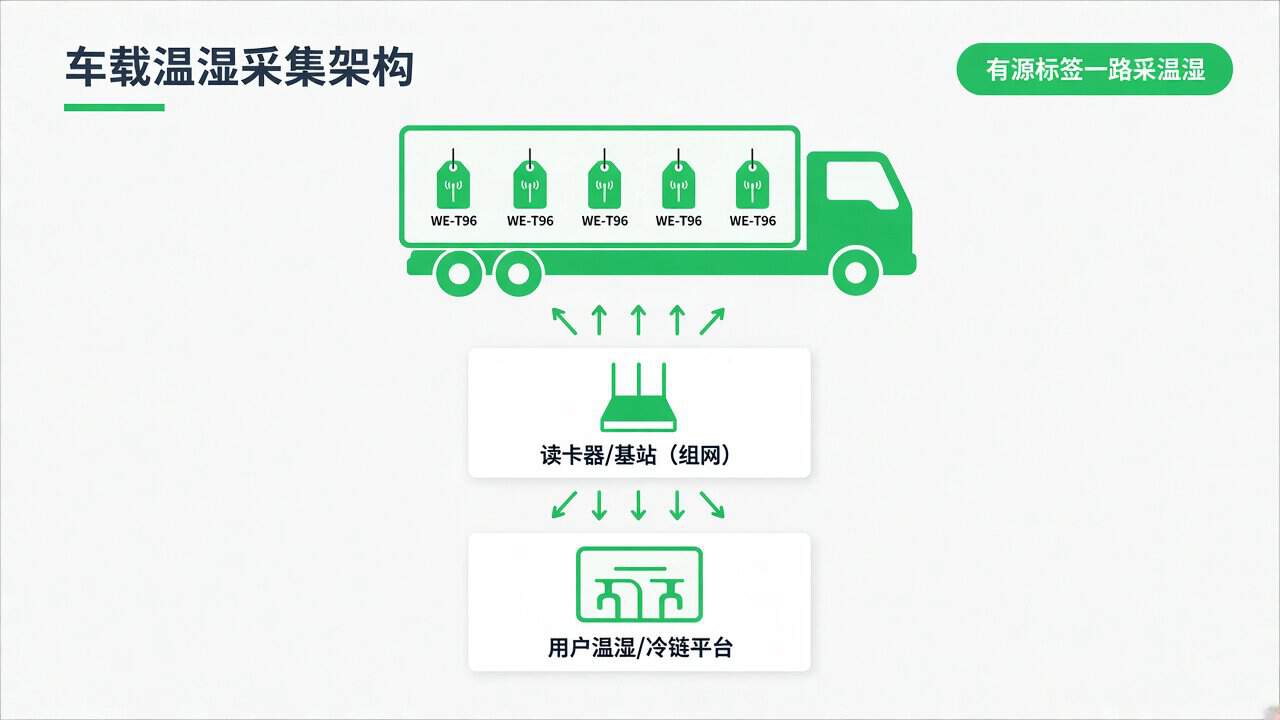
Positioning: for vehicle / cold-chain scenarios,active-tag temperature and humidity sensing(tag-side hero)—not a standalone weather-station solution, and not a forced cloud SaaS bundle.
Typical chain (conceptual): cabin/slot WE-T96 temp/humidity tag → 2.4G wireless report (default about every 3 s) → companion reader/base (4G or network backhaul) → user temp/humidity monitoring / WMS / cold-chain platform (secondary integration).
- A · In-transit vehicle monitoring: Stick or screw-mount the tag on the cabin wall or near a slot; mount the reader on the truck or cover the yard; temp/humidity data go through the reader to the user system for in-transit exception handling.
- B · Cold-store environment (side use): The same tag can sense cold-store / cool-room environments; this page’s main story stays fresh vehicle-side, with warehouse as an extension.
Core hardware
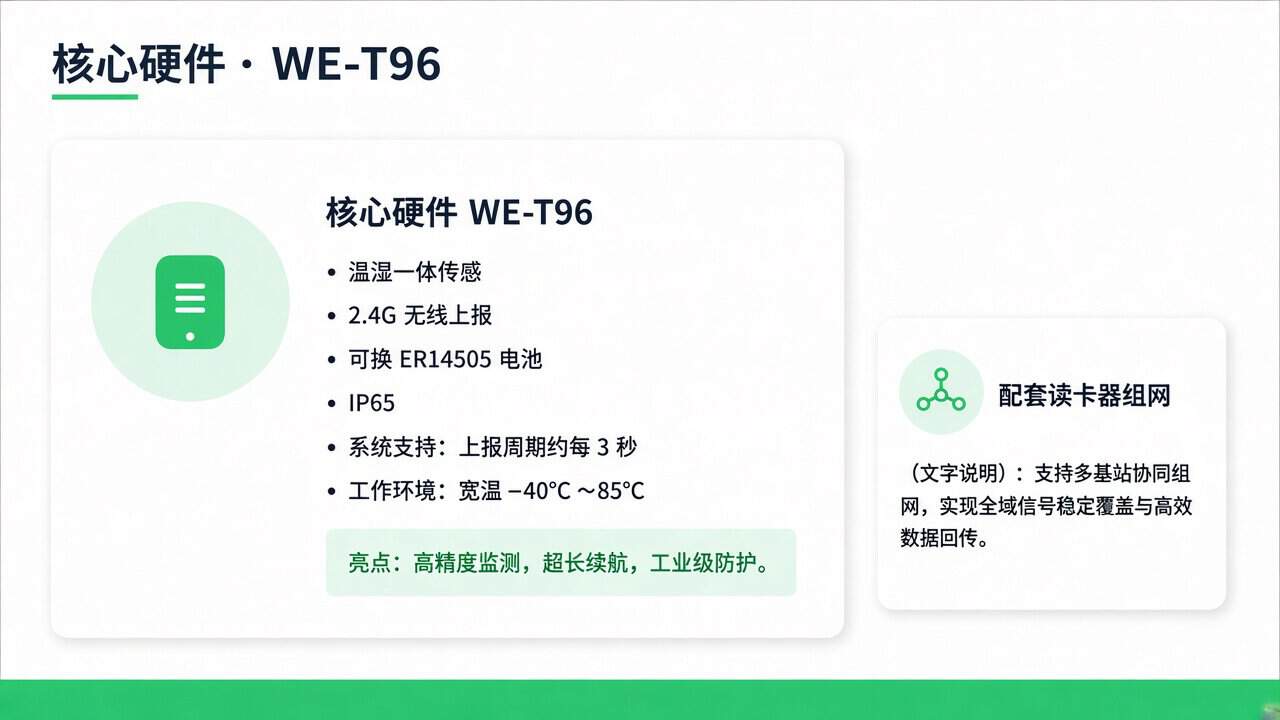
Long-range temp/humidity electronic tag WE-T96: 2.4G; transmit power about 3 mW; about 100 m-class wireless reporting in open conditions (manual: up to 100 m; live product page: about 150 m in the open; implementation follows on-site obstruction measurement); temperature −40°C to 85°C (±1°C, accuracy conditions in the manual); humidity 10%–90%RH (±3%RH, conditions in the manual); replaceable ER14505 about 2600 mAh; default report about every 3 s; reference continuous operation no less than 3 years; IP65; about 61×36×25 mm / 30 g; mount with 3M adhesive or screws.
Companion readers/bases are described in words only: tag side radios to the reader; reader side uses 4G or wired network to the user platform. Integration goes through inquiry and tech support.
Deployment and integration
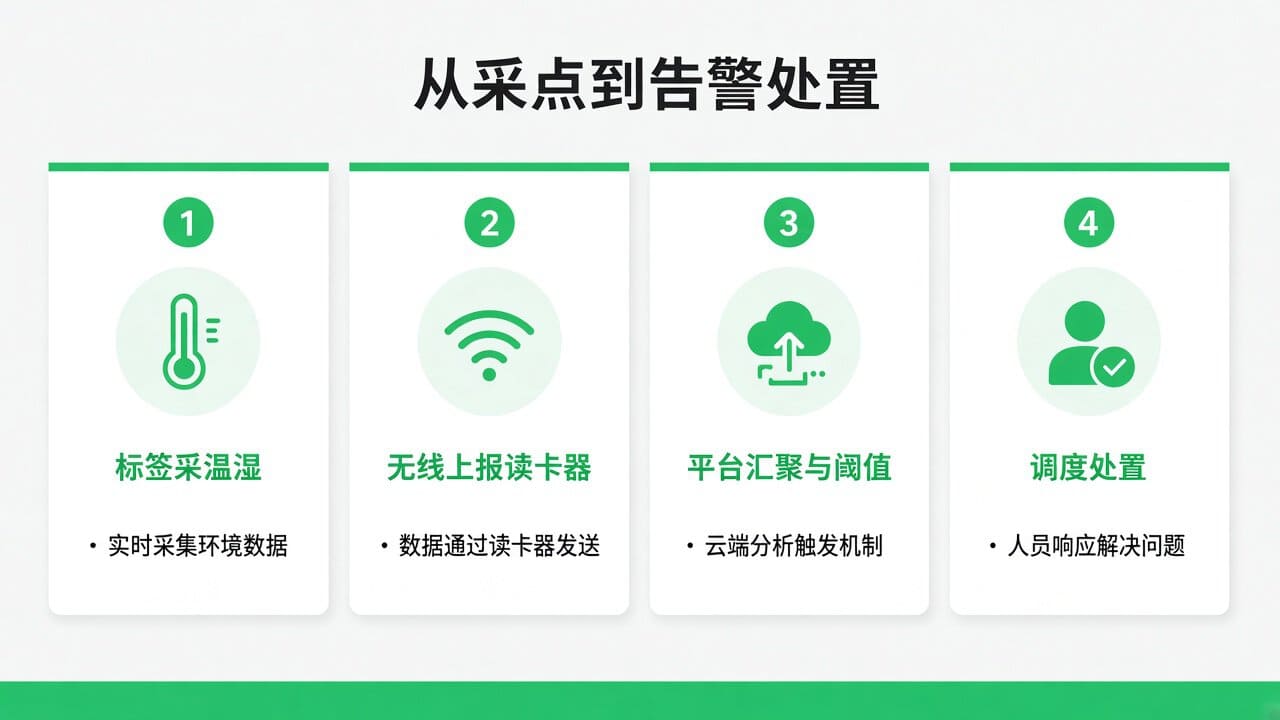
- Tag mounting: On cabin walls, crate sides, or slot brackets—per the manual use 3M adhesive or screws; avoid dense metal shielding and sealed metal cavities.
- Sensing strategy: Default report about every 3 s (factory-customizable); response to temp/humidity change within 60 s. Confirm any custom period with implementers based on cabin sealing and platform sampling needs.
- Networking / backhaul: Tag radios to the reader; reader uses 4G / wired network to the user platform.
- Battery and maintenance: Replaceable ER14505 battery; low-voltage alert; manual says about 30 days after low voltage for scheduled swap.
- Data content (conceptual): Reports include tag ID, type, low-voltage/battery fields, and temp/humidity extension bytes (0.1°C / 1%RH); parse details follow the reader manual and tech support.
Suitable scenarios
- Fresh delivery / cold-chain transfer vehicles: continuous in-cabin temp/humidity sensing and exception discovery.
- Fresh warehouse/delivery: vehicle temp/humidity sensing, optionally alongside active-tag find-goods apps (find-goods details in another brief).
- Cold store / cool room / pharmacy storage: zone temp/humidity patrol sensing.
- Outdoor / semi-outdoor rain-exposed sites needing IP65, replaceable battery, and −40°C to 85°C range.
Five implementation steps
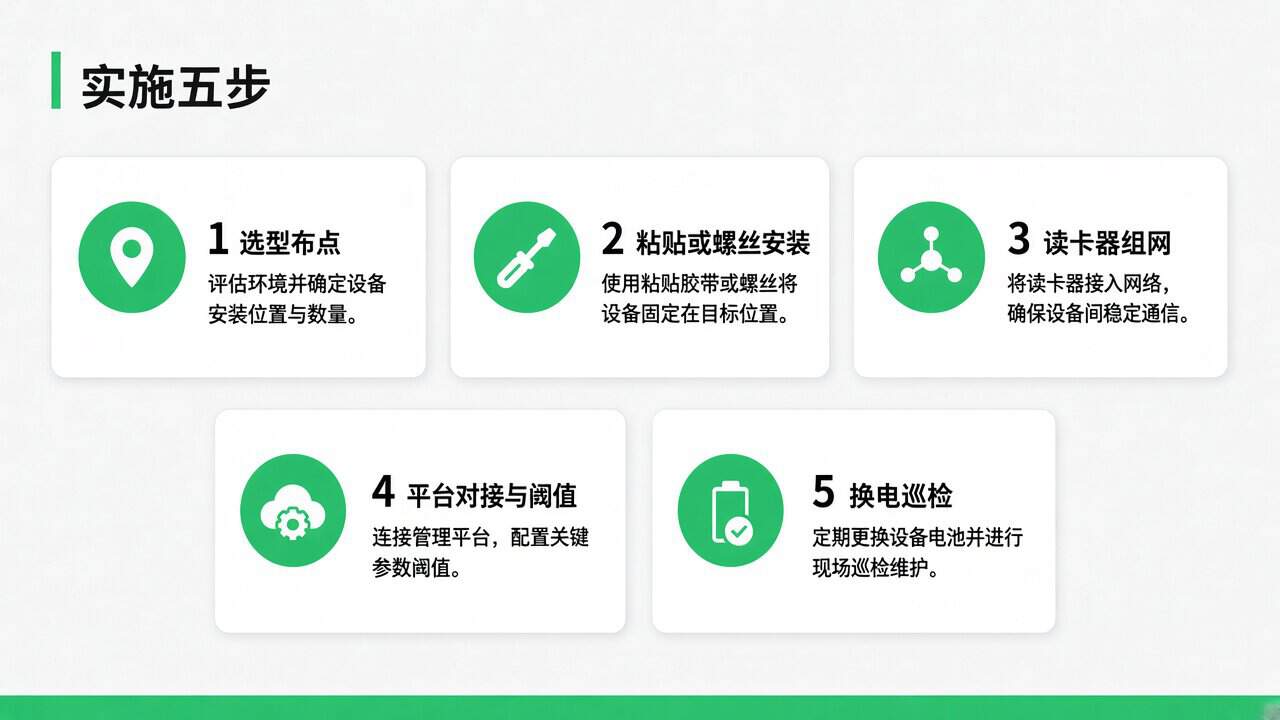
- Selection and placement
- Adhesive / screw mounting
- Reader networking
- Platform integration and thresholds
- Battery swap and inspection
Related products
Specs / manual:WE-T96 product manual (PDF)
Inquire
Need help sizing cabin placement, report interval, or reader networking? Use the inquiry form—no online list price.
→ Contact us
Content Reviewer: Josh Xu
 简体中文
 English